Fur, Flames, and FAQs: the Rise of Alt.fan.furry
When furries pop up in mainstream media, I get worried. Normie accounts of furry have long misrepresented the fandom, presenting us before the wider public as sexual deviants, adult children, mentally ill. Historically speaking, we’re not celebrated; we’re diagnosed. And while the tired stereotypes have gradually given way to more positive (or at least more neutral) takes, you can imagine my reaction when I stumbled upon a 1996 American Civil Liberties Union (ACLU) affidavit by an individual “known on the Internet […] as Vulpine or Tod T. Fox” (Vulpine, “Affidavit”).
“I have been participating in online communities for about seven years,” Vulpine writes in the affidavit (Vulpine, “Affidavit”). He goes on to detail his involvement in everything from mailing lists on Arthurian scholarship to furry newsgroups to MUCKs including FurToonia and FurryMUCK, where he volunteered to help program new locations. “Being online has been a wonderful and valuable experience for me. It has improved my writing and creativity skills. ‘Building’ a section of the MUCKs is a complex but very rewarding experience” (Vulpine, “Affidavit”). So…Why an affidavit? What was the problem?
The problem was that Vulpine wasn’t yet an adult. To stay active on FurryMUCK, he had to lie about his age.
It’s February 1996. The world wide web is still new. Unsure how to regulate this massively game-changing technology, the US Congress passes the Communications Decency Act, or CDA. “Intended to protect minors from unsuitable internet material, the Act criminalized the intentional transmission of ‘obscene or indecent’ messages,” among other things (“Reno vs. ACLU,” Oyez). As a result of the CDA’s lack of clarity around what constitutes “obscene or indecent” material, web-based organizations scramble to change their community rules. Places like FurryMUCK institute identity verification: send the chief admin your real name, date of birth, and state/country, or else you will be designated as a minor. Policies like this turn into free speech issues. Since FurryMUCK’s new policy means sharing personal information, Vulpine argues, “[a]dults are faced with the choice of abandoning their anonymity or getting treated like a minor” (Vulpine, “Affidavit”).
Vulpine stood by his choice to lie about his age, and for that decision he was toaded — kicked out of FurryMUCK. But on alt.fan.furry, the most popular furry newsgroup at the time, the decision (and the affidavit) created, in Vulpine’s own words, “an uproar.” In a discussion thread called “Vulpine’s ACLU affidavit,” he expresses his disappointment at having been booted from FurryMUCK. The 301 replies that follow are nothing if not a testament to furry fandom’s propensity for discourse — a community furiously debating its morals and standards. For a lot of furs, Vulpine’s case is cut-and-dry: you knew the rules; you broke them. Some agree with the decision to ban Vulpine but express sympathy: “I heartily agree with the sentiment that we should be fighting the CDA,” writes Shaterri, a FurryMUCK founder and wizard, “but frankly, Furry’s fears are greater than the CDA.” (FurryMUCK, at the time, was often referred to simply as Furry.) Others defend Vulpine, arguing that his decision is “consistent and supportable […] a reasonable act of civil disobedience.” Some jump to Vulpine’s defense, too, on account of what he was contributing to FurryMUCK and Furtoonia—literally helping build the virtual worlds that made it possible for furries to meet each other (Vulpine, “Vulpine’s ACLU Affidavit”).
The thread became a flame war — a series of hostile or provocative replies on a given thread. But is that all it was? Should we write off the whole discussion because some folks were unnecessarily rude and harsh?
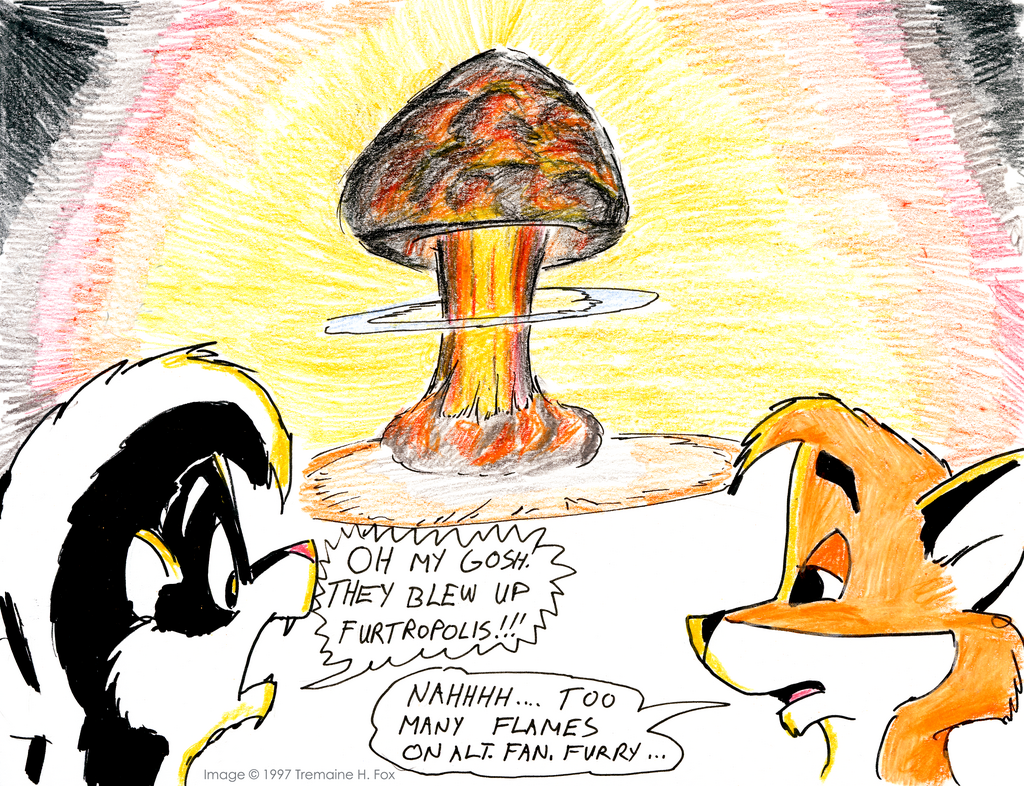
There is a common sentiment that furry newsgroups, alt.fan.furry foremost among them, amounted to little more than an endless series of flame wars. In this article, I offer a different historical perspective. While furry newsgroups certainly had their flame wars, they were also sites where furry fandom was figuring out its own identity. Particularly in the early days, before 1996, many threads focus on building community: sharing recommendations for furry books and movies, FAQs about furry identity and meaning, discussions on art and characters and cons. When they did happen, arguments tended to be dominated by a smaller subset of users—no doubt part of the reason for the 1997 offshoot group, alt.fan.furry.bleachers, a play on the idea that folks there would watch a.f.f. drama unfold from the stands!
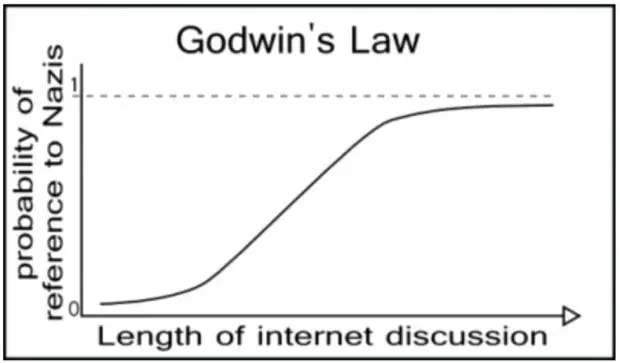
Flames could all too easily dwarf the more rational discourse that was happening. The “Vulpine’s ACLU affidavit” thread is a perfect example. Throughout the thread, folks do disagree with each other, sometimes in language vitriolic and extreme. Comparison to Nazism was alive and well in the early internet days, so much so that attorney Mike Godwin created Godwin’s Law in an effort “to create a disincentive for frivolous or reflexive Hitler or Nazi comparisons” (Godwin). Yet what goes ignored are the folks who make rational arguments, provide examples, and occasionally throw in jokes to lighten the mood. No, it’s not rainbows and sunshine, but neither is it a hellscape of animosity. To describe furry newsgroups as little more than flamewars is to overlook the important ways that the fandom was shaping its own identity on these platforms.
From a historical perspective, then, it’s less a question of “Why was alt.fan.furry a constant flame war?” and more “How did alt.fan.furry get to be KNOWN as a constant flame wars?” By the late 90s the newsgroup’s flame wars had earned it the nickname “Alt.flame.furry.” These disputes (and the influx of this new annoyance called spam) precipitated the creation of offshoot groups including alt.lifestyle.furry and the fur.* (furrynet) hierarchy (AberDeen Foxx; Baird). It is, however, important to contextualize these conflicts. Flaming was a problem that got worse over time and concurrently with other issues — e.g., the CDA and fears about internet regulation, disagreements about supposed mayhem at ConFurence, and arguments about the sexualization of the fandom that would culminate in the Burned Furs movement.
Alt.fan.furry came to be known for the drama, and perhaps drama has an outsized influence on how we remember things. But an historical pattern that I noticed across several newsgroups boils down to: connect, define, splinter. Early on, newsgroups were connection points, places to connect about fandom. Then there would follow the ongoing work of defining the newsgroup’s purpose (and defining furry itself). Finally, disagreement around a group’s purpose (combined with other issues) would lead to splintering. This is a vast oversimplification, but it’s helpful in getting the bigger picture. I’ll talk about this pattern after describing the birth of alt.fan.furry.
While furry newsgroups certainly had their flame wars, they were also sites where furry fandom was figuring out its own identity.
The birth of alt.fan.furry
After the birth of the internet but before the blossoming of the world wide web, common ways of communicating electronically included BBSs (bulletin board services), internet relay chat (IRC), and Usenet groups. It should come as no surprise that furries—who after all run the internet—were experimenting with these platforms. A BBS was a computer server running a service that allowed users to connect, making it possible to read bulletins, upload and download data, and post messages (“Bulletin Board Systems”). “Dialing into a BBS felt like whole-body teleportation,” writes journalist Benj Edwards. “It was the intimacy of direct, computer-to-computer connection that did it. To call a BBS was to visit the private residence of a fellow computer fan electronically.”
Established in 1979, Usenet was “the first non-governmental platform-agnostic computer communication network” (“Usenet”). Similar to Reddit, Usenet allows users to write and respond to discussion posts. Usenet groups, called newsgroups, lack a central server and for the most part also lack moderation. As Arrow said to me, “[I]t was really kind of a wild west” (Arrow, interview). Because of the fast proliferation of newsgroup topics in the 80s, the Great Renaming of 1987 classified newsgroups according to “the Big Eight hierarchy: comp.*, humanities.*, misc.*, news.*, rec.*, sci.*, soc.*, and talk.*” Specific newsgroups, in other words, developed a bit like subreddits, functioning under the umbrella of broader topic areas. Since you needed a two-thirds vote by Usenet admins to approve new groups within the Big Eight hierarchy, “alt.” was added as an unofficial, more accessible hierarchy (“Usenet”).
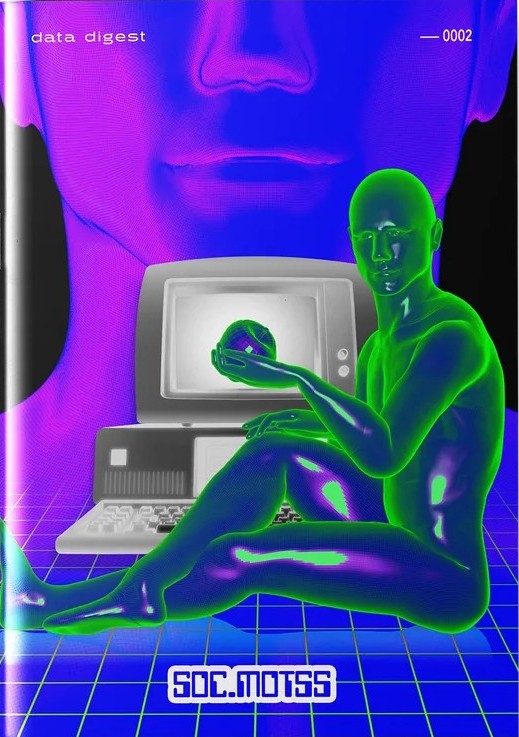
Usenet quickly became a resource for queer connectivity. In 1983, when furry was just beginning to be seen as a concept distinct from funny animals, programmer Steve Dyer created net.motss (later soc.motss) — i.e., net dot “members of the same sex.” Not unlike how FurryMUCK helped gay furries express themselves in ways that were riskier in real life, “[f]or some, net.motss was the first place where they felt comfortable coming out as gay. A few years after its founding, regular members began meeting up at in-person industry events such as USENIX conferences” (“Usenet”).
Furries had a presence across Usenet even before dedicated furry groups got up and running. In December 1989, Shaterri posted a farewell message in alt.callahans (a fangroup for Spider Robinson’s Callahan’s Crosstime Saloon) that included excerpts from a document called “Furry Fandom Observed” by non-furry author Dr. Pepper (“Dr. Pepper”). On soc.motss, weeks before the formation of alt.fan.furry, there is gay furry porn featuring a human and a Kzin (cat-like species introduced in Larry Niven’s Known Space series). By 1992, furry — in the sense of furry fandom, not the commonly used adjective in gay bear culture — had enough of a presence to come up in a soc.motss discussion. In a digressive comment, the user jokes about adding “bifurcations” — “events which happen with delicious regularity on FurryMUCK” — to Ciaran McHale’s satirical Bisexual Dictionary (Cleland). Apparently even in 1992 there was a notable presence of bi-folk on FurryMUCK!
What’s more, Usenet was more than just text discussions. “USENET had two main components: the text forums for discussion of various topics, and the much larger groups for the exchange of binaries, mostly image files but also other things. Before the Web it was the only way to distribute art that wasn’t an FTP site” (Cargie, interview). Before the fur.* hierarchy got up and running in 1996, the best-known furry binaries were alt.binaries.pictures.furry and alt.binaries.pictures.erotica.furry (though one user laments that, by 1998, both groups had been overtaken by non-furry content and spam) (Raccoon). Images could be shared on the binary groups through a process called uuencoding, short for Unix-to-Unix encoding. Uuencoding turned binary data into plain text. A single image might require a long series of posts because of how much text data there was. You would then uudecode the text back into binary data and open it in an image program. Ta-da: you’ve downloaded one (1) art!
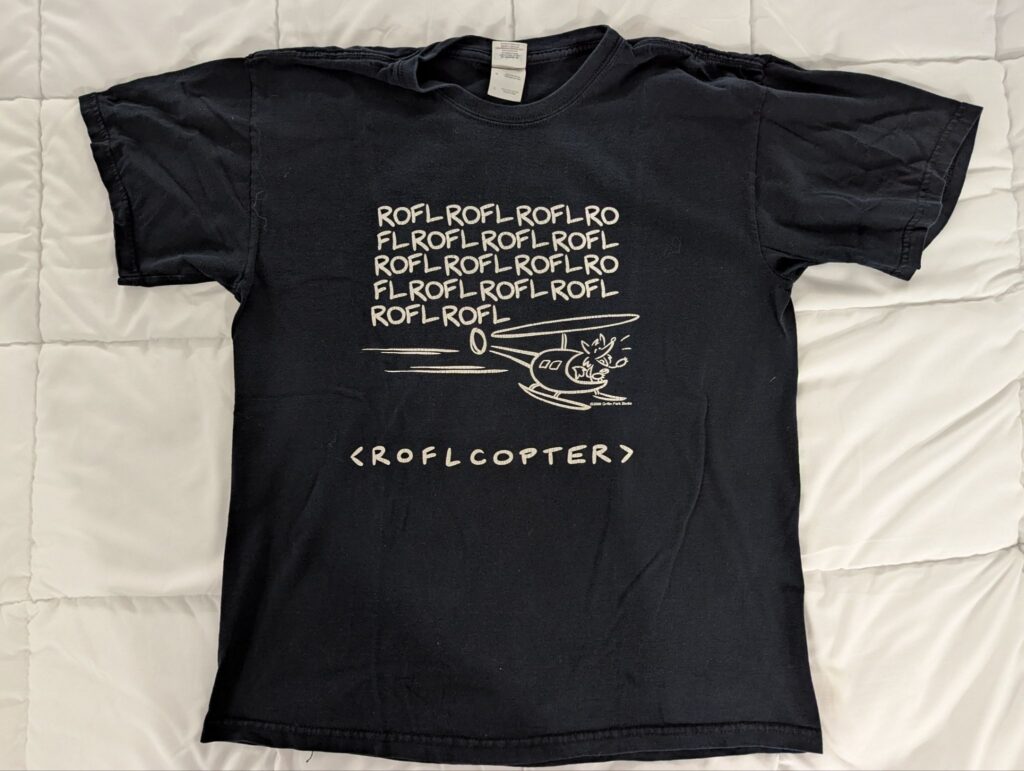
According to wikifur, alt.fan.furry was created on December 18, 1990 (“alt.fan.furry”), and that it was founded by Tzoq. Tzoq, whom I interviewed for this article, remembers it a little differently. As with a lot of other furs at the time, Tzoq was drawn to the fandom by Stan Sakai’s Usagi Yojimbo (1984), Steve Gallaci’s Albedo Anthropomorphics (1983), and others. Albedo fans had created alt.fan.albedo, “which, thanks to the bonus stories in the comic, was turning into a general-purpose Furry discussion group—the only thing of its kind at the time” (Tzoq, interview). Alt.fan.furry grew directly from users in alt.fan.albedo:
I think people agreed pretty early on that a new group would be a good idea, but the argument just shifted to what to call it. If I’m remembering correctly (which is a big if), there were a lot of suggestions around the word “anthropomorphics” which made it sound more like a place to discuss academic publications than anything. (This tendency also came out in things like the fanzine YARF!, whose subtitle was “The Journal of Applied Anthropomorphics” – which is a fun joke, but maybe not the clearest name for a newsgroup.)
As I remember, I was more in the “keep it simple” camp, and suggested “alt.fan.furry”. I don’t think I actually *created* the newsgroup. I seem to recall that being Tugrik. (Tzoq, interview)
In what would become fairly standard practice with new newsgroups, a few early posts ask for clarification on what the group is for. Yippee Coyote offers what holds up as a pretty solid gloss on furry fandom and its origins (Yippee):
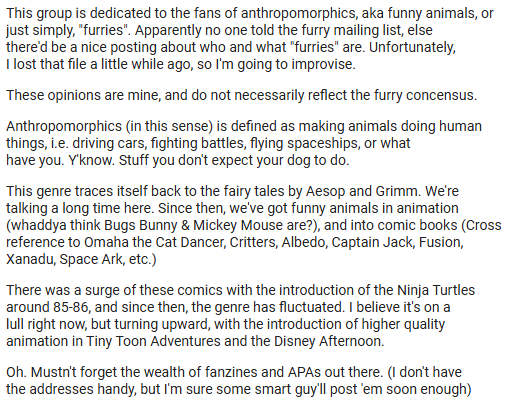
Before long, alt.fan.furry would take on a life of its own.
Connect
In other articles, I have described furry as an “e-tinerant” community, trying to capture—in true furry bad-pun spirit—the ways in which we have navigated across internet spaces, adapting and responding to changes in popular platforms (and developing many of our own). It is important to understand furry newsgroups as part of an early furry ecosystem that included different ways of exchanging information.
Wander the main areas of a con and you’ll find tables full of posters for parties, websites, programming of all sorts. Early furry internet locales operated similarly; they were hubs for one another, and sometimes for in-person events. In the early 90s, Yasha the Centaur “read about the ‘furry muck’ on [alt.fan.furry]. And I started hanging out there. […] This is where I really started ‘socializing’” (Yasha, interview). Timber Coyote told me about discovering lists of furry Usenet groups via BBSs. “I didn’t really have any way to access [the newsgroups], but this was a tantalizing window into what people were really talking about, a thin glimpse into discussions beyond what was available in books and TV and media, and I pored over it” (Timber, interview). Tzoq said, “I first went to Islandia MUD in 1991, which I learned about on a.f.f. I moved over to FurryMUCK soon after that.” (Tzoq, interview).
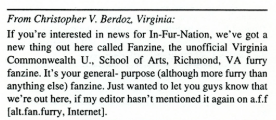
Cargie Weasel told me about how different platforms attracted different kinds of conversation: “[W]e had furrymuck and others for chat and socialising, we had newsgroups for posting, and ftp archives for exchanging art” (Cargie, interview). This division allowed folks to determine their favorite hangout spots. “I was more of an IRC and FurryMUCK guy,” Arrow said to me (Arrow, interview). But for the same reason, as Tybolt noted, it also created an issue with cohesion. “[I]t was very much several interlocked spheres between IRC especially, the MUCKs and MUDs and a slew of mailing lists that may be extremely lost media” (Tybolt, interview).
In November 1992, the were-creatures found each other on a different newsgroup: alt.horror.werewolves. The AHWW FAQ notes that “it was intended for discussion of horror-genre movies and books dealing with werewolves.” Over time, “conversations shifted to discuss what werewolves meant to [users] personally. […] As the discussion grew more and more philosophical, a concept known as spiritual therianthropy was formed” (Bubenik). While therian identity and media predate the internet, AHWW was one of the earliest internet forums for therian folk. AHWW users would write werecards, which were posts that described in great detail their were-phenotypes and backgrounds. The were-curious could find all kinds of conversations around different types of shifting, mental and physical. And unsurprisingly, questions came up around boundaries: Is this a group about horror movies or about werewolf identity? Are were-creatures furries or not? How do we talk about kinks and sexuality connected to our were identities?
The history of alt.horror.werewolves, or AHWW, will require another article, but it was yet another place were-creatures furry, therian, and otherwise could mix and mingle. What’s more, it even inspired in-person meetups. In 1994, Smash Greywolf started Harvest Howl, held at Valley Lake Campground in Southington, Ohio. The AHWW archives suggest that the first Howl gathered weres from many different states, underscoring just how influential these newgroups could be in helping connect likeminded internet users.
Define
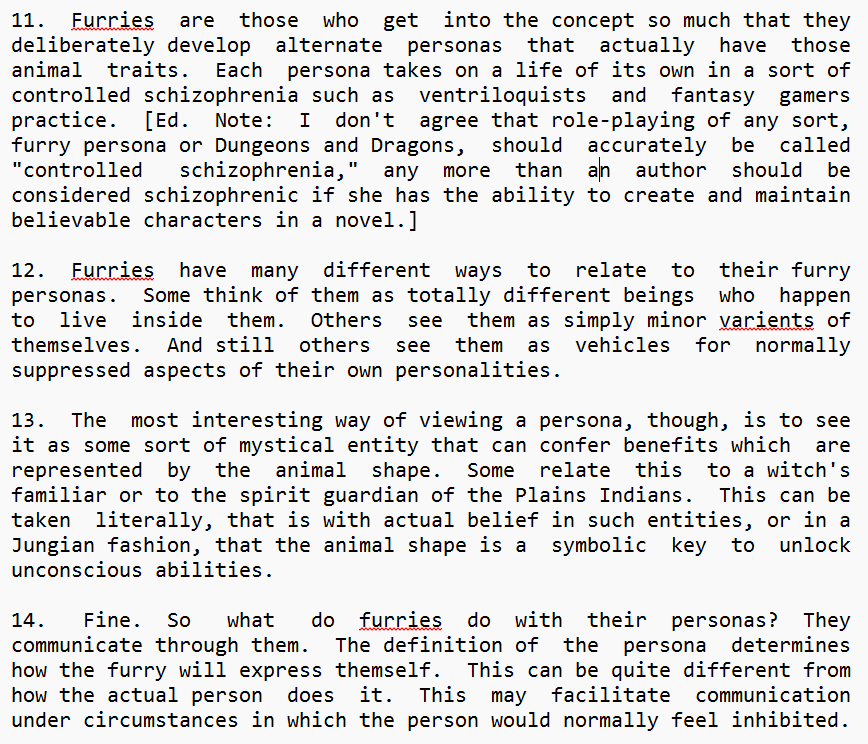
Not unlike how AHWW brough folks together for Harvest Howl, Alt.fan.furry was a place where furries could plan for ConFurence. It was also a place where furry was finding itself. I’ve already mentioned Dr. Pepper’s short essay, “Furry Fandom Observed.” Published in Watts Martin’s fanzine Furbyte 1 (March, 1990), though circulating earlier on BBS’s, “Furry Fandom Observed” was often quoted when new newsgroup users asked what furry was all about. Some part of the definition withstand the test of time. Others…not so much:
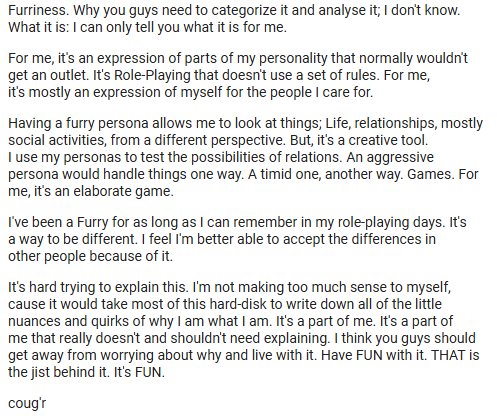
One of my favorite definitions is Ken Coug’r’s reply to the conversation that follows on Dr. Pepper’s original post and gets recirculated with it:
Around the same time, several alt.fan.furry users post requests for FAQ – something to help explain furry and the purpose of the newsgroup. FAQs were very common in newsgroups because, well, the medium attracted frequently asked questions (often from new users). On alt.fan.furry, Greywolf took up the challenge and published an FAQ for the group in July, 1993, which included another definition of furry:
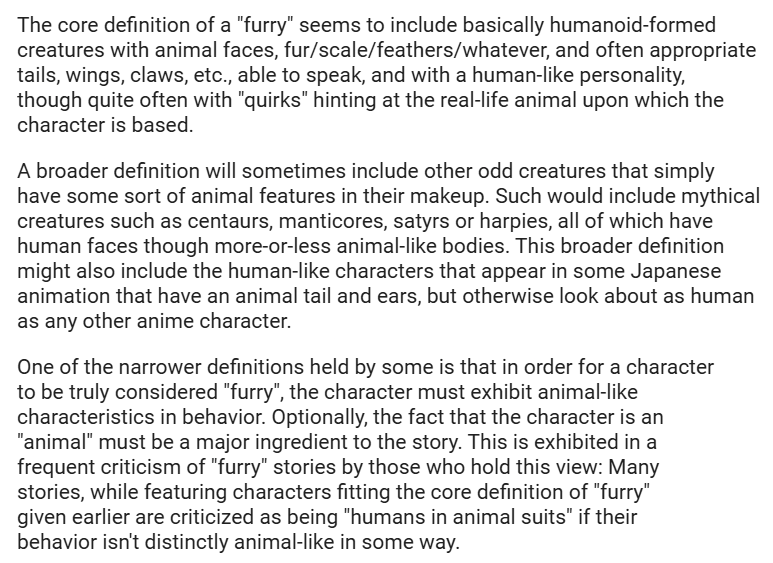
Part of what’s interesting is how the conversation around furry definition changes over time. A lot of folks bristled against Dr. Pepper’s medicalizing definition of furry roleplaying as “controlled schizophrenia” and as a way of letting out “suppressed” emotions. Ken Coug’r resists the urge to define and categorize. Furry is different for everyone; the important thing is to “[h]ave FUN with it.” Greywolf offers a “core definition” but acknowledges that the term is fluid and there is no agreed-upon definition.
Greywolf’s definition remained part of the alt.fan.furry FAQ, but over time new questions and answers were added to the list that nuanced furry’s definition. “CAN REPTILES BE ‘FURRY’?” is a question that started to appear in the 1994 version of the FAQ. “Yes. So can birds. The term is not necessarily literal.” Greywolf also added distinctions between funny animals (“an anthropomorphized animal, though the usage tends to lean more toward more “cartoony” characters”), personal furry (an early near-synonym for fursona), and — one you don’t hear so often anymore — critter, which Greywolf defined as “an alternative loose term for referring to anthropomorphized humanoid characters” (Greywolf, FAQ, 1994).
Even with the FAQ being released at monthly intervals, a lot of new folks to the newsgroups come in asking what furry is. These queries produce a lot of personal stories about how folks define their own furryness. There was even something called the “net furry survey” from 1991. The survey mostly asks about favorite furry media, and “the results were predictable. Albedo/Gallacci/Erma Felna was the overwhelming favorite, with Xanadu/Vicky Wyman a notable second. Yarf! and ECP were also mentioned, as were Monika Livingston, Omaha, Red Shetland, Usagi Yojimbo” (Aleph Null).
Splinter
In addition to answering common questions, FAQs “were probably as close to ‘rules’ as one could get” (Tybolt, interview). Tybolt shared some commonly broken rules with me, including users using excessively long signatures or not preserving a clean division between the text groups and the binaries groups.
Anecdotally speaking, in my youth I’d used a set-top box at one point (WebTV, it’s a whole other early internet appliance rabbit hole!) but its newsreader was very powerful in that it had very few restrictions for embedding HTML and such into posts and signatures which resulted in a lot of flame wars in the early Pokémon fandom communities because PC users would oftentimes get crashed by posts from WebTV users who didn’t know the “etiquette”. (Tybolt, interview).
The biggest etiquette issue, though, was more fundamental: users treating one another disrespectfully. A lot of newsgroup posts are needlessly rude. And the same topics come up again and again, raising the specter of…
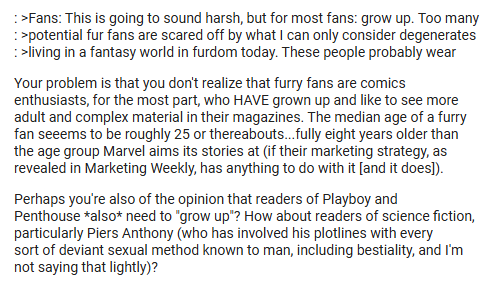
There are a lot of conversations archived on alt.fan.furry; how do you find the drama? Here’s a little historian trick: look for the threads with hundreds of posts. In a post called “What Is Wrong With Furry Fandom Today,” one user admonishes furry comics for having fallen in quality and having become “little more than all out furry fuck-fests”; chastises ConFurence because “They want to run it like a 1,000-person furry party, and it has grown too large to run that way”; and indeed castigates fur fans themselves. “This is going to sound harsh, but for most fans: grow up. So many fur fans that I come into contact with act like fur fandom is their life, and if that’s true, you should check into a rubber room” (Henderson).
As you might imagine, this post produced a deluge of responses. There is no easy way to categorize the responses. Some folks agree, adding additional perspectives, including “back-in-my-day”-type arguments that laud some version of a past fandom. Others push back:
It’s not that every thread on alt.fan.furry started a flame war. The vast majority did not. Most threads are short — a post followed by a few responses. A lot of posts are fans being fans: posting lists of furry movies and zines, and definitions of furry; sharing their own furry stories and asking questions; sharing links to FTPs and FurryMUCK tips and even tips on preserving artworks from the passage of time (bless you, early furry preservationists!) (Whittier). But as time goes on, 1996-1998, there are a lot more posts; a lot more to keep up with; a lot more ingroup familiarity and (therefore) less patience. There are more folks expressing fatigue over divisiveness and conflict. In one thread that devolves into an argument between two users, a third user writes, “I am SO FUCKING SICK of this feud appearing once every five or six months just like clockwork. And one will say ‘This is my last post on the matter,’ until they see that the other had posted something so HORRIBLE that just had to reply, and so it goes. Round and round and round” (Atara).
Shared interests brought folks together into newsgroups; drama and flamewars splintered them apart. This is how offshoot groups, such as alt.lifestyle.furry, were formed. We’re back to 1996, a few months after the debate around Vulpine’s ACLU affidavit. In Reno v. American Civil Liberties Union, the US Supreme Court held up the decision by the Third Circuit Court of Appeals that parts of the CDA infringed on free speech on account of its poorly-defined terms (“Reno v. ACLU”). A win for the free internet, but users across platforms were still shaken.
Wikifur reports that alt.lifestyle.furry (or A.L.F.) formed in June 1996 in response to “a vitriolic flamewar on alt.fan.furry, during which the furry community was largely divided into those who believed the term furry applied only to art, and those who believed it applied to anything which the individual wanted it to” (“alt.lifestyle.furry”). The 108-post thread in which Tirran first proposes the name alt.lifestyle.furry is called “Reasons against furry” and begins with user Taura Learfox enumerating reasons why furries and Christian religions don’t see eye to eye. What begins as a debate around the language of the Bible and Christian beliefs becomes a numbing discussion on different sects of Christianity and how they would or would not feel about furries. This, in turn, morphs into a discussion around what “furry” means, with some users worried about an equivalence between furry and bestiality or plushophilia. Furry artist Richard Bartrop asks, “Should those of us who did not get involved for the lifestyle issues define ourselves as separate from those who insist that it is? If so, what should we call ourselves?” (Bartrop).
It is reply to this question that Lupercal proposes the idea of a furry lifestyle-centered newsgroup:
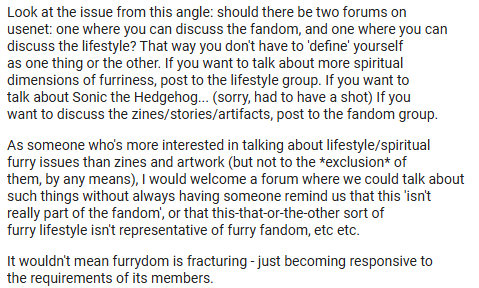
Lupercal’s reply registers the fatigue of discourse – how tiring it is for someone to say “this isn’t really part of the fandom” — a persistent sentiment in furry that everyone from lifestylers to babyfurs to pups have had to deal with over and over. Why must we always be negotiating in-group and out-group? Why not just think of furry as an umbrella under which fall many interests? Tirran echoes this sentiment in the post that proposes the name alt.lifestyle.furry:
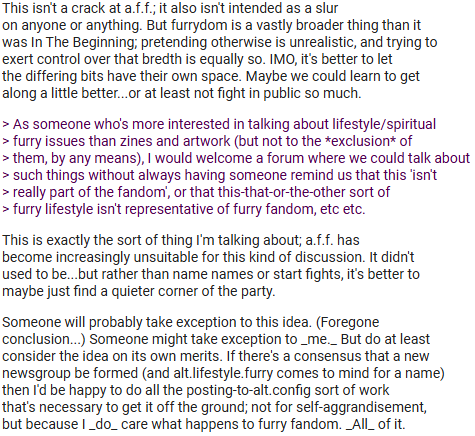
What’s important about Tirran’s and Lupercal’s posts is that their proposed alt.lifestyle.furry is precisely not about splintering. The point they make is that furry is getting more nuanced, and they just want a space where discussions around furry-as-lifestyle can happen without assholes dropping in and telling them that that’s not what furry is about. Indeed the a.l.f. original FAQ notes that “It’s part of the philosophy of ALF that a person’s ‘furry lifestyle’ is whatever the person concerned asserts that it is.” There is even a section on definitions:
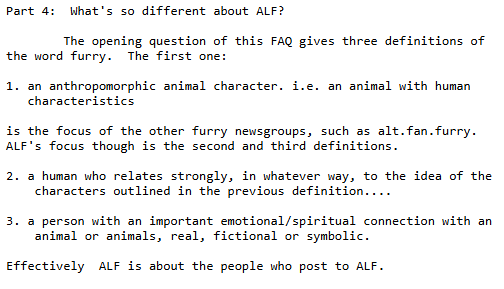
While alt.fan.furry was not created as a splinter group, it came to be perceived as such. More to the point, there were furries who simply couldn’t stomach the idea of furry lifestylers (this was one of the things that the Burned Furs would call out as little more than mental illness a couple years later).
More to the Story
However one felt (or feels) about Vulpine’s 1996 decision to lie about his age, he did something a lot of folks wouldn’t have the courage to do: he supported the nascent furry internet community. The alt.fan.furry community had a lot to say about that, and as much as it was a flame war it was also a space where furry fandom was developing its own, internal community standards and norms. There is a lot more to the story of alt.fan.furry and furry newsgroups writ large — no doubt the subject of future posts (I’m looking at you, alt.horror.werewolves 👀). But as far as it’s early history goes, it’s important to understand that alt.fan.furry wasn’t an ongoing ball of flame; most of the time it was a connection point for the fur-curious, one locale in the blossoming furry e-cosystem.
Works Cited
Note: this article relies on Usenet archives available via Google Groups. In 2001, Google acquired the Usenet discussion group archives of Deja News Research Service. Deja’s — and therefore Google Groups’ — archives are not necessarily complete. Many furries reported that these archives are missing content. As a result, my own research for this article is necessarily limited to what’s available.
Alt.fan.furry posts consulted
AberDeen Foxx. “FUR: Everyfur switch to fur.*” alt.fan.furry Google Groups archive. <link>
Aleph Null, “Hey Ho! It’s a furry survey!” October 9, 1991. Alt.fan.furry Google Groups archive. <link>
Atara. Post in the thread “BOC’s latest tirade,” by furplay. November 28, 1999. Alt.fan.furry Google Groups archive. <link>
Baird, Chris. “[FAQ] Introduction to the Furrynet (fur.*) newsgroups.” November 15, 1996. Alt.fan.furry Google Groups archive. <link>
Bartrop, Richard. Post in the thread “Reasons against furry,” by Taura LearFox. July 16, 1993. Alt.fan.furry Google Groups archive. <link>
Greywolf, “How ‘bout this for an FAQ?” [first edition of alt.fan.furry FAQ]. July 27, 1993. Alt.fan.furry Google Groups archive. <link>
Henderson, Brian. “Repost: Furry Fandom.” December 13, 1994. Alt.fan.furry Google Groups archive. <link>
Kill. Post in the thread thread “BOC’s latest tirade,” by furplay. November 28, 1999. Alt.fan.furry Google Groups archive. <link>
Lupercal. Post in the thread “Reasons against furry,” by Taura LearFox. July 17, 1996. Alt.fan.furry Google Groups archive. <link>
Raccoon. Post in the thread “alt.fan.furry.art,” by Raccoon. October 14, 1998. Alt.fan.furry Google Groups archive. <link>
Tirran. Post in the thread “Reasons against furry,” by Taura LearFox. July 17, 1996. Alt.fan.furry Google Groups archive. <link>
Vulpine. “Vulpine’s ACLU Affidvait.” March 23, 1996. Alt.fan.furry Google Groups archive. <link>
Whittier, Terry. “Artwork Preservations FAQ.” March 23, 1995. Alt.fan.furry Google Groups archive. <link>
Yippee Coyote. Post in the thread “the purpose of this group,” James A Obrien. December 18, 1990. Alt.fan.furry Google Groups archive. <link>
Other sources
Arrow Wolf. Interview (Telegram). June, 2025.
“Alt.fan.furry.” Wikifur. Last modified August 17, 2020. <link>
Bubenik, Katie “Wakko!”. “Alt.horror.werewolves Core-FAQ.” FAQs.org. Last modified February 3, 1997. <link>
“Bulletin Board Systems.” Queer Digital History Project. Accessed May 1, 2016. <link>
Cargie Weasel. Interview (Telegram). June, 2025.
Cleland, Thom. Post in reply in soc.motss thread “Strangest conversations had while in bed.” June 18, 1992. Soc.motss Google Groups archive. <link>
“Dr. Pepper.” Wikifur. Last modified March 7, 2012. <link>
Dr. Pepper. “Furry Fandom Observed.” Furbytes 1 (March, 1990).
Edwards, Benj. “The Lost Civilization of Dial-Up Bulletin Board Systems.” The Atlantic. November 4, 2016. <link>
Godwin, Mike. “I created Godwin’s Law in 1990, but it wasn’t a prediction – it was a warning.” R Street. May 31, 2016. <link>
Lupercan and Tirren. “Alt.lifestyle.furry FAQ.” Tigerden [now accessible on Wayback Machine]. Last modified May 8, 2001. <link>
Reno v. ACLU, 521 U.S. 844 (1997). <link>
Reno v. ACLU. Oyez. Accessed 28 May. 2026. <link>
Timber Coyote. Interview (Telegram). June, 2025.
Tybolt. Interview (Telegram). July, 2025.
Tzoq. Interview (google docs). August, 2025.
“Usenet.” Queer Digital History Project. Accessed May 1, 2016. <link>
Vulpine. “Affidavit of Christopher O’Connell Ransohoff in ACLU, et al v. Reno.” ACLU. <link>
Yasha the Centaur. Interview (Telegram). September, 2025.

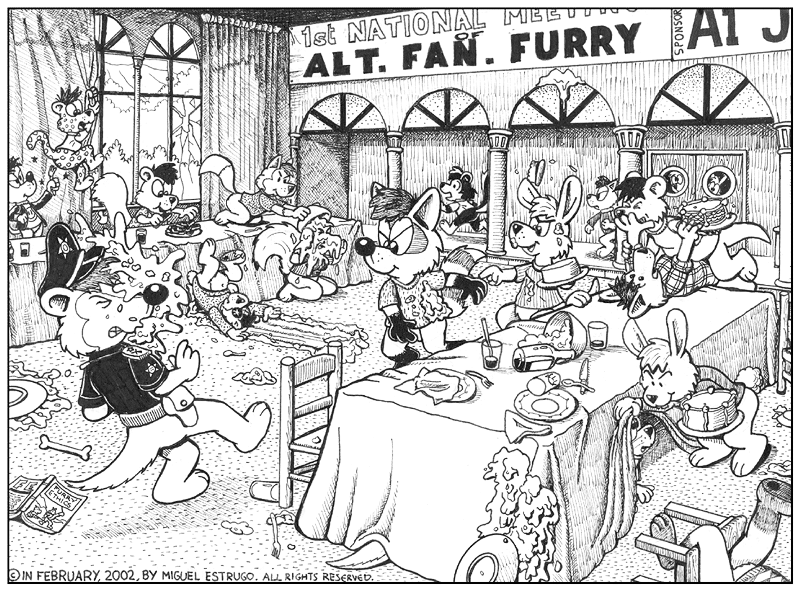
It’s interesting to me that most of the images are noticeably newer than the events described in the text. Not surprising, of course, for the reasons you mentioned about sharing images on Usenet and lost media. But the fact that they exist tells its own story.
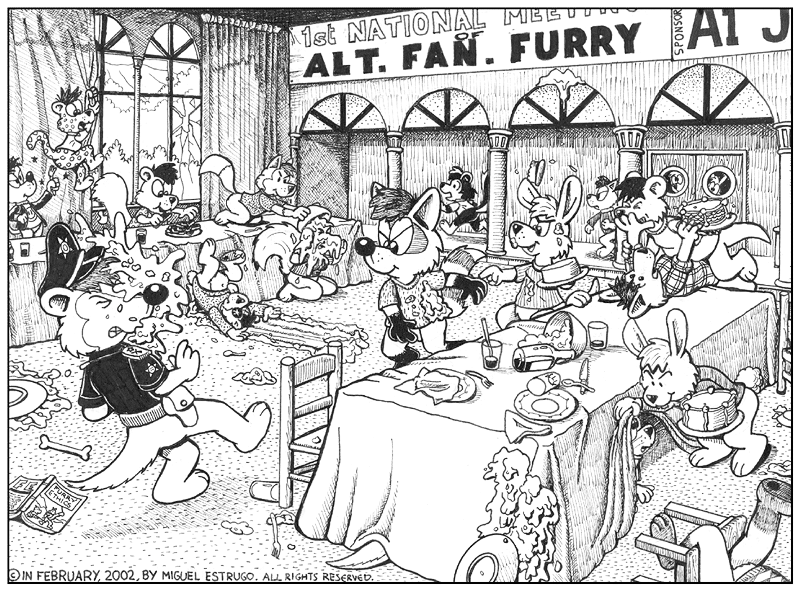
I think the popular belief is that Usenet was effectively dead by the end of the nineties. The fact that Artie Roo’s comic is dated 2002 pushes back against that. Maybe a.f.f’s heydey was over, but it was at least active or influential enough to inspire art years into the aughts.
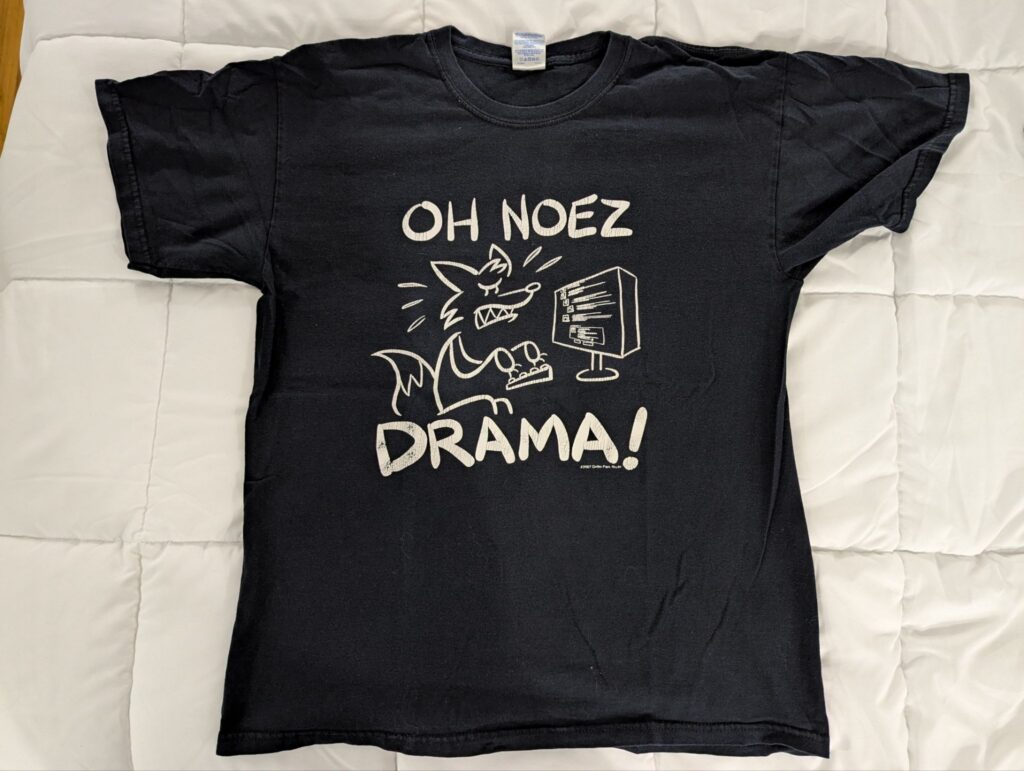
The shirts jumped out at me because roflcopter is filed in my brain as a web forum meme. Sure enough, Know Your Meme dates the first use to a 2004 post. But the fact that Tzoq has them helps paint a through line from Usenet to there.
Thanks for this!